Telephone: +86-0512-65028068
Content
An anti-theft screw looks like an ordinary fastener right up to the moment somebody tries to take it out. The difference lives in the drive recess: instead of a Phillips cross or a plain hex socket, the head carries a shape that no everyday tool will fit. That single design decision turns a low-cost screw into a small but effective deterrent, which is why tamper-proof fasteners appear on licence plates, vending machines, lift panels, street lighting and outdoor signage.
We make these fasteners every day at Suzhou Anzhikou Hardware Technology Co., Ltd. Our plant covers 2,000 square metres and runs more than 200 imported machines for cold heading, thread rolling, CNC machining and anti-loosening processing, with sizes running from M0.6 micro screws up to M10. The notes below come from that shop floor experience, and they are written for engineers, buyers and maintenance teams who need to choose a security screw that genuinely works in service.
Security fasteners are not unbreakable, and nobody should sell them that way. A determined person with a drill, a rotary tool or a welder can defeat almost any screw. What an anti-theft screw does is change the economics of the job: it removes the option of walking up with a screwdriver and taking the part off in fifteen seconds. The fastener forces the wrong person to carry the right tool, spend more time, and accept more noise and more visible damage.
Four mechanisms do this work, and most products combine one of the first three with the fourth:
The practical question is never "which screw cannot be removed" but "who should be able to remove it, and with what". Once you answer that, the drive type, material and finish usually follow.
Drive geometry is the heart of the specification. The table below covers the styles we are asked for most, together with the tool each one needs and where they usually end up.
| Drive style | Tool required | Typical applications | What to watch for |
|---|---|---|---|
| Pin-in-Torx (Torx TR) | Torx TR security bit | Electronics housings, automotive trim, battery covers | The centre post blocks a standard Torx key |
| Snake eye / spanner | Spanner bit | Lift panels, washroom partitions, mirrors, signage | The driver slips out of the two round holes |
| Tri-groove (tri-wing) | Tri-groove driver | Vending machines, transit fittings, panels | Lower torque capacity, so use it with care |
| Pentagon socket | Pentagon key | Licence plates, utility cabinets, kiosks | Five-sided recess; keys are easy to control |
| Heptagon / seven-lobe | Matching special key | Metering, high-security enclosures | Tooling is less common, so keep spare keys on site |
| One-way slotted | Flat blade to install | Exit signs, public signage, one-time fixing | Removal normally means drilling the head |
Two things are worth noticing. First, the more unusual the geometry, the harder the screw is to source in the exact length, diameter, head and finish you need, which is why most security projects end up as a custom order rather than a catalogue pick. Second, the drive should match the level of control you want. A pin-in-Torx suits a serviceable panel that a technician opens regularly, while a one-way slot is better for a sign that should never come down again. A stainless steel snake-eye screw is a good middle ground for lift and partition work, where the fixing must resist casual tampering but still come apart on a maintenance visit.
.jpg) M4 stainless steel pan head security screw with snake eyeStainless steel, Steel, Aluminum, Brass, etc.View Product →
M4 stainless steel pan head security screw with snake eyeStainless steel, Steel, Aluminum, Brass, etc.View Product →Number plates are the classic case. The screws have to survive road spray, salt, vibration and repeated pressure washing while staying impossible to undo with a household screwdriver. A pentagon socket or a snake-eye head in 304 or 316 stainless steel is the usual answer, often with a sealing washer behind the head so water does not creep into the panel. Because plates are replaced on a schedule, the removal tool should stay in the hands of the workshop or the authority rather than the public, and a tamper-proof button head with its own key gives that control directly.
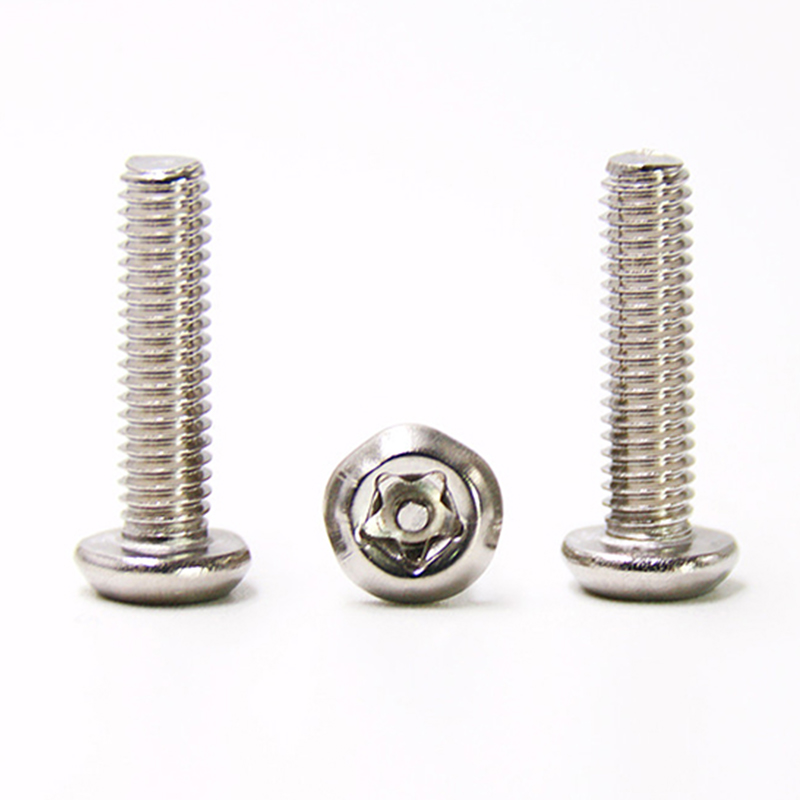 Stainless-steel-button-head-pentagon-tamper-proof-screw-with-keyWaterproof & Anti-Loosening Socket Head Cap ScrewsView Product →
Inside phones, laptops, cameras, watches and measuring instruments the screws are tiny, with M1, M1.2, M1.4 and M1.6 routine, and the goal shifts. A pin-in-Torx or a five-lobe recess keeps a curious owner out of a sealed assembly without adding weight or height. Here the specification is dominated by tolerance, head height and finish: a CD-pattern or satin-brushed flat head, black oxide or a thin zinc coating, and a pre-applied thread lock so the fastener survives thousands of vibration cycles.
Vending machines, bus shelters, park benches, bicycle racks and utility cabinets take the heaviest punishment. Tri-groove and one-way screws are popular because the driver is small, cheap to keep on a maintenance keyring and useless to a casual passer-by. Use a larger diameter and a corrosion-resistant finish, and if the assembly faces constant vibration add a nylon patch or a thread-lock coating rather than relying on the drive alone.
The base metal decides how long the fixing survives, and the finish decides how it looks while it does so. The four families we supply most often are:
Finishes matter as much as the base metal. Black oxide, blue-white zinc, colour zinc, nickel plating and black zinc are all common on security screws, while anodising and CD-pattern or satin brushing are used where the fastener stays visible. On a security screw the finish is also a visibility decision: a black screw on a black bracket is easy to overlook, whereas a bright zinc head invites attention.
Finally, deal with loosening. A nylon patch applied to the thread creates friction that holds the screw in place through vibration, and it combines neatly with a security drive so the fastener resists both removal and self-loosening. Pre-applied thread-lock coatings, sealing coatings and O-ring grooves serve the same purpose where liquid or dust ingress is a concern. A black carbon steel anti-theft screw with a nylon patch, for example, gives a tamper-proof head and a vibration-resistant thread in one part.
-1.jpg) M4 carbon steel black anti theft screws with nylon patchStainless steel, Steel, Aluminum, Brass, etc.View Product →
M4 carbon steel black anti theft screws with nylon patchStainless steel, Steel, Aluminum, Brass, etc.View Product →Most tamper-proof screws are not bought off the shelf. A short, complete specification saves weeks of back-and-forth, so put these points on the drawing before you ask for a quotation:
If you would like to see how that process runs end to end, our OEM custom screw programme covers tooling, first-article sampling and repeat production from the same drawing.
Those questions are worth more than a price list, and you can read more about the equipment and the people behind our own production on the about page.
Anti-theft screws are a small line on a bill of materials and one of the cheapest ways to protect an asset, a panel or a piece of public infrastructure. The right choice is rarely the most exotic drive on the market. It is the drive that matches the threat, the service schedule and the environment, in a material and finish that will still be intact when the screw finally has to come out.
If you are still weighing up options, send us a drawing, a sample or even a photograph of the joint. We will come back with a practical recommendation on drive type, material, coating and locking method, and tell you honestly where a security screw helps and where a different approach would serve you better.
CONTACT DETAILS

Address:NO. 248-2 Changhongbei Road, Luzhi Town, Wu zhong District,Suzhou City, Jiangsu Province,China.
TEL:+86-13913588597
PRODUCTS
MOBILE TERMINAL




 English
 Español
.jpg "Customized color hex socket m3 titanium bolt for bike")
.jpg "Customized m5 stainless steel pan head flat washer screws")
.jpg "Customized stainless steel flat spiral recliner tension spring")
.jpg "Custom stainless steel 316 compression spring for ball pen")
.jpg "Custom black stainless steel compression spring")
-1.jpg "Customized brass inserts injection molded for plastic")