Industry knowledge
ISO 7380-1 vs ISO 7380-2: Understanding the Structural Difference Between Standard and Flanged Button Head Screws
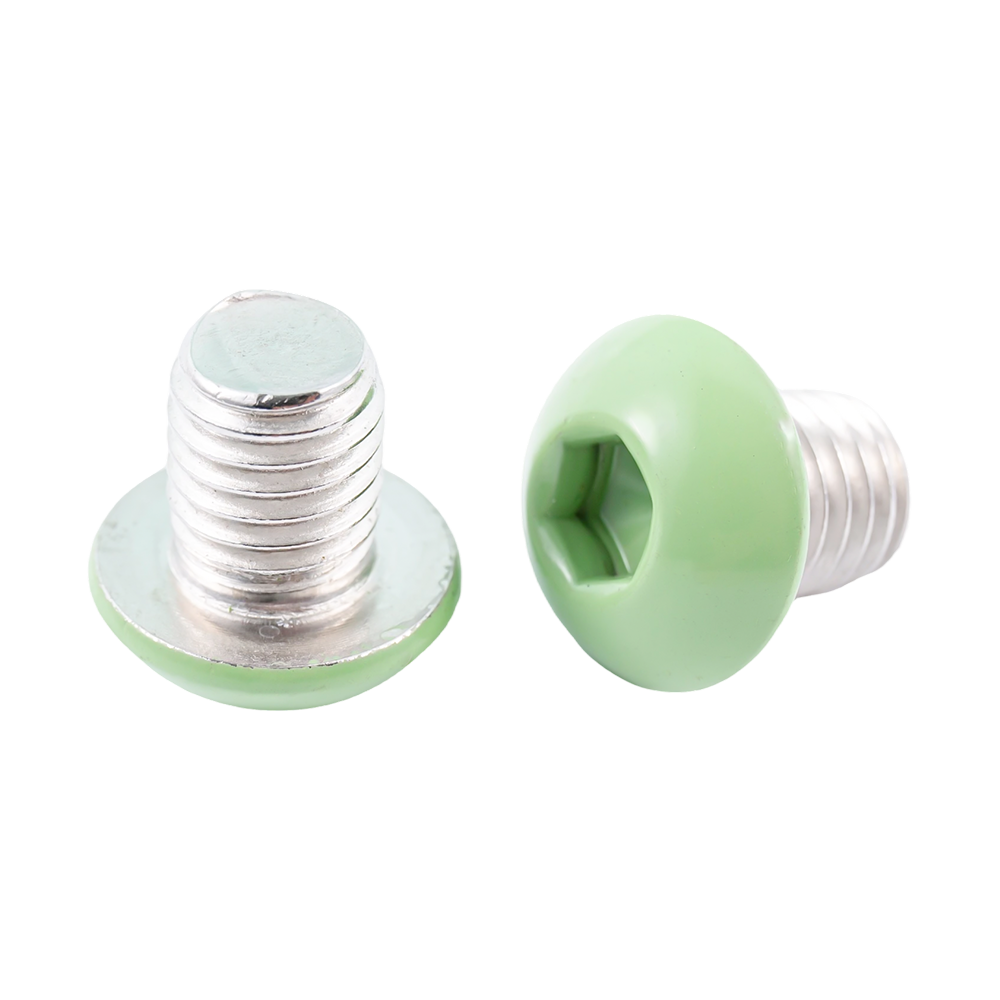
ISO 7380 is published in two distinct parts that are frequently conflated in procurement and engineering documentation, leading to incorrect substitutions that compromise joint performance. ISO 7380-1 defines the button head socket cap screw with a plain domed head and no flange — the head bearing surface is limited to the circular underside of the dome itself. ISO 7380-2 defines the flanged variant, which adds an integral washer flange beneath the domed head, increasing the bearing surface diameter by approximately 30% to 40% relative to the head diameter for the same nominal screw size. This difference is not cosmetic: the flange fundamentally changes the compressive stress distribution at the joint surface and determines whether the screw is suitable for use in softer substrate materials without a separate washer.
The head height specified in ISO 7380-1 is nominally equal to one-quarter of the nominal screw diameter — significantly lower than the equivalent ISO 4762 socket head cap screw, whose head height equals approximately two-thirds of the nominal diameter. This reduced head height is the defining functional characteristic of the button head design: it allows use in shallow counterbore pockets, provides a low-profile external appearance on the assembly surface, and reduces interference risk with adjacent sliding components or covers. The trade-off is a proportionally shorter hex socket engagement depth, which directly limits the maximum installation torque and therefore the achievable preload — a verification step that is frequently skipped when button heads are selected purely on the basis of their low-profile appearance.
Bearing Stress Limits: When ISO 7380 Button Heads Require a Washer Despite the Standard Not Mandating One
The bearing stress generated beneath the head of an ISO 7380 screw during installation is higher than for an equivalent ISO 4762 socket cap screw of the same nominal diameter, because the button head's bearing area is smaller in proportion to the proof load that the screw can sustain. When this bearing stress exceeds the compressive yield strength of the joint material at the contact zone, the head embeds progressively into the surface with each thermal cycle or vibration event, eliminating preload and causing joint relaxation without any visible external indication of failure.
| Joint Material |
Compressive Yield Strength (MPa) |
Risk with ISO 7380-1 (No Washer) |
Recommended Action |
| Structural steel (S275) |
275 |
Low |
Standard installation acceptable |
| Aluminium 6061-T6 |
276 |
Moderate (M5 and below) |
Use ISO 7380-2 flanged or add washer for M5 and smaller |
| Aluminium 5052-H32 |
193 |
High (all sizes) |
Washer or flanged head mandatory |
| Magnesium alloy (AZ31) |
97 |
Very High |
Large-OD hardened washer required regardless of head type |
| Engineering plastic (PC/ABS) |
55–75 |
Extremely High |
Metal insert or through-bolt configuration required |
The ISO 7380-2 flanged button head was specifically developed to address this bearing stress problem in lightweight alloy assemblies without requiring a separate loose washer component. The integral flange increases the bearing area by a factor of approximately 1.6 to 1.9 depending on nominal size, reducing bearing stress proportionally and extending the range of substrate materials in which the screw can be used at full proof load without embedment risk.
Property Class Selection for ISO 7380 Screws: Why 10.9 Is Not Always Superior to 8.8 in Button Head Applications
ISO 7380 button head screws are commercially produced in property classes 8.8 and 10.9 for carbon and alloy steel, and in austenitic stainless grades A2-70 and A4-70. The instinct to specify the highest available property class for any structural fastener application is specifically problematic for ISO 7380 button heads because the limiting factor in most button head joints is not the screw's tensile capacity but the socket's torsional capacity. The hex socket in an ISO 7380 button head has a socket depth approximately 37% shorter than an ISO 4762 cap screw of the same nominal diameter. When a 10.9-grade screw demands installation torque of 14 to 16 N·m to achieve proof load preload, but the short socket can only sustain 10 to 12 N·m before socket distortion initiates, the higher property class becomes counterproductive.
The practical guidance for ISO 7380 property class selection is therefore:
- M3 to M6 range: Property class 8.8 is appropriate for the majority of applications. The socket depth at these sizes provides reliable torque transmission to 8.8 proof load without risk of socket damage when a correctly sized, unworn hex key is used.
- M8 to M12 range: Property class 10.9 becomes feasible because the larger absolute socket depth provides sufficient engagement for the higher torque requirement. However, socket condition must be monitored rigorously — worn hex keys at M8 and above can strip a 10.9-grade ISO 7380 socket in a single installation event.
- When maximum preload is mandatory in small diameters: Consider switching to ISO 4762 socket cap screws in the same location rather than upgrading the property class of an ISO 7380. The taller head height of ISO 4762 provides the socket depth needed to safely transmit 10.9-grade installation torque.
- Stainless steel grades (A2-70, A4-70): Anti-seize compound and controlled installation speed are mandatory for stainless button heads in stainless tapped holes to avoid galling.
Surface Treatment Options for ISO 7380 Screws and Their Impact on Dimensional Compliance
ISO 7380 specifies the mechanical and dimensional properties of the screw in the uncoated condition, and surface treatments applied after manufacture add material to the external surfaces that must be accounted for when verifying dimensional compliance. The coating options most widely applied to ISO 7380 button head screws, along with their dimensional and performance implications, are:
- Black oxide: Adds less than 0.0005mm to all surfaces and has no measurable effect on thread class or head dimensional compliance. Standard finish for indoor mechanical assemblies, tooling fixtures, and electronic enclosures where a non-reflective black appearance is specified.
- Zinc electroplating (clear or yellow chromate): Adds 5 to 12 microns per surface. Plating above 10 microns on 6g threads risks tight-fit or gauge failure and requires the base screw to be produced to a 6e tolerance class to provide plating allowance.
- Nickel plating: Produces a bright, corrosion-resistant surface at 8 to 15 microns per side. Nickel-plated button heads in applications with skin contact must be tested for nickel release compliance with EU REACH Annex XVII Entry 27.
- Dacromet / geomet flake coating: Applied at 8 to 20 microns total thickness, providing 500 to 1,000+ hours salt spray resistance with no hydrogen embrittlement risk. The higher friction coefficient (0.12 to 0.16) must be accounted for in torque specification — the same installation torque produces approximately 15% less preload compared to zinc-plated screws.
- PVD coatings (TiN, CrN, DLC): Applied at 1 to 4 microns, PVD adds negligible dimensional growth while providing surface hardness of 1,500 to 5,000 HV. Specified in high-end cycling components, medical devices, and precision optical instruments.
Counterbore and Clearance Hole Design for ISO 7380 Installations: Avoiding the Most Common Drawing Errors
ISO 7380 button head screws are most frequently installed in counterbored holes that recess the domed head below or flush with the assembly surface. The geometry of these counterbores is routinely specified incorrectly on engineering drawings. The three most common drawing errors for ISO 7380 counterbore specifications and their consequences are:
- Specifying counterbore depth equal to nominal head height: With dimensional tolerances on both the screw and the machined counterbore, the dome will either protrude slightly above the surface or sit below flush. Correct practice adds 0.1mm to 0.2mm to the nominal head height when specifying counterbore depth to ensure consistent flush-or-below seating.
- Using a flat-bottomed counterbore for domed heads: A flat-bottomed cylindrical counterbore contacts the dome only at its perimeter edge, creating a line contact that concentrates stress and provides no lateral stabilization for the screw head under shear loading. The correct counterbore diameter is 0.3mm to 0.5mm larger than the nominal head diameter.
- Failing to specify hex key access clearance above the counterbore: Designs that provide only 5mm to 8mm of clearance above the counterbore require either a ball-end hex key (which reduces transmissible torque by 25% to 30%) or a T-handle hex driver — both of which must be accounted for in the specified installation torque.
Non-Standard ISO 7380 Variants: Custom Head Diameters, Extended Socket Depths, and Low-Magnetic Options
The standard dimensional series defined in ISO 7380 covers nominal sizes M3 through M16 with fixed head diameter and height ratios. In many precision engineering applications, these standard ratios do not optimally match the design requirements, and custom variants of the button head form are specified to address specific functional needs.
Extended Head Diameter for Increased Bearing Area
Increasing the head diameter beyond the ISO 7380 standard while maintaining the button head dome profile produces a fastener with substantially higher bearing area that eliminates the need for a separate washer in soft substrate applications. Custom head diameters of 1.5× to 2.0× the standard ISO 7380 head diameter are feasible through cold heading in a custom die and are commercially produced in batches of 5,000 pieces or more. The dome profile must be redesigned proportionally when the head diameter is increased to maintain the intended low-profile appearance.
Extended Socket Depth for Higher Torque Transmission
Producing an ISO 7380-profile head with a socket depth matching or approaching the ISO 4762 standard creates a hybrid geometry that delivers the low-profile outer appearance of a button head with the socket engagement and torque capacity of a cap screw. This non-standard configuration is used in applications where maximum preload is required but the protruding cylindrical head of an ISO 4762 screw is unacceptable. The increased socket depth is achieved by specifying a greater head height in the cold heading tooling, typically adding 0.5mm to 1.5mm beyond the ISO 7380 standard for sizes M4 through M8. Suzhou Anzhikou's in-house tooling capability enables custom socket depth specifications to be incorporated into the heading die design and validated through first-article inspection before production release.
Low-Magnetic and Non-Magnetic Grades
Standard austenitic stainless steel ISO 7380 screws have a low but non-zero magnetic permeability due to the deformation-induced martensite that forms during the cold heading process. For applications in MRI equipment, magnetometer assemblies, and precision compass instruments, truly non-magnetic ISO 7380 button heads require either a post-heading solution anneal or specification of a superaustenitic alloy grade such as 316LN or 904L. These non-magnetic variants are custom items produced in small batches to customer specification, and verifying the magnetic permeability of finished screws requires Helmholtz coil measurement or a calibrated permeability meter — a standard hall-effect magnet test is insufficient to detect the small permeability increases that fail precision instrument specifications.

 English
 Español