Telephone: +86-0512-65028068
Content
Walk down the apron of almost any flying club and you will see the same scene: a few rings set into concrete decades ago, chains that have seen better days, and at least one anchor that nobody on the field really trusts. Tying an aircraft down on concrete looks simple enough, yet that small piece of hardware works quietly through every gust, and the slab beneath it is far less forgiving than turf.
We make fasteners for a living, including eye bolts and mounting hardware that end up outdoors in exactly this kind of service. The questions we hear from operators and maintenance teams about concrete tiedown points tend to repeat themselves, so this guide gathers the practical answers: which anchor types exist, how to install one without embarrassing yourself, and which part of the assembly usually fails first.
On grass, a tiedown is mostly a story about soil friction and a long stake. On concrete, the load path runs through a mechanical or bonded connection into a slab that may be 100 to 200 mm thick, sometimes reinforced, sometimes not, and often of unknown age. Three things drive the design:
A concrete anchor that has not been selected for those loads is really just a hole with a bolt in it. It may hold for years and then let go on the one night that matters.
Most aprons end up with a mixture of systems. Knowing how each one transfers load makes it much easier to judge what you are looking at during a walk-around.
| Anchor type | How it holds | Best suited to | Watch-outs |
|---|---|---|---|
| Cast-in ring or loop | Ring or hooked bar embedded before the pour, often on a steel plate | New aprons and permanent parking boxes | Strongest option, but position is fixed and mistakes are expensive |
| Mechanical wedge or sleeve anchor | Tapered expander pulls a sleeve or clip against the drilled hole wall | Retrofit work in sound, uncracked slabs | Sensitive to hole quality; vibration can loosen it over time |
| Adhesive (epoxy) anchor | Threaded stud bonded into the hole with a two-part resin | Older or lightly cracked concrete, tighter edge distances | Hole must be clean, dry and fully cured before loading |
| Screw-in concrete anchor | Hardened coarse threads cut their own path into the concrete | Quick, semi-permanent tie-off points | Smaller diameter means lower capacity; easy to over-torque |
| Bolted surface plate with eye nut | Steel plate anchored to the slab, carrying an eye bolt or ring | Points that must be removable, raised or replaced | Rate the plate, bolts and eye as one system, not separately |
| Ballast blocks or weighted drums | Weight alone, with no connection into the slab | Overflow parking and short visits only | Can slide or be lifted in a strong gust; not a permanent anchor |
The mistake to avoid is treating all of these as equivalent because they look similar from standing height. A cast-in ring and a screw-in anchor can sit a metre apart on the same apron and have very different reserve strength.
The sequence below is the one we would follow on a retrofit job, and it is deliberately conservative. On a live airfield, always clear the work with the operator and the airport authority first.
The two steps that get skipped most often are hole cleaning and sealing. Water sitting in an anchor hole works its way down during freeze-thaw cycles and eventually spalls the patch around the anchor, which is a slow, quiet way to lose capacity.
Anchor manufacturers publish ultimate pull-out and shear values for specific concrete strengths, embedment depths and edge distances. Those figures are test results, not working limits, so a safety factor has to be applied on top of them. A common field approach is to design for at least three times the expected static load and then check the result against local requirements, because gust loading on a parked airframe is neither static nor predictable.
Three constraints tend to govern real installations. Edge distance matters more than most people expect: an anchor placed close to a slab joint or a free edge can fail by breaking out a chunk of concrete rather than by pulling out. Spacing between anchors matters too, since closely grouped anchors share the same concrete volume. And slab thickness limits how deeply any anchor can be set.
For background reading, the FAA advisory circular on tiedowns (AC 20-35C) is still a sensible starting point, and many airport authorities publish their own tiedown standards that take precedence on their property. Where the loads are unusual, a structural engineer is cheaper than a repair bill.
A perfectly good anchor connected to a hardware-store eye bolt is a weak link with a strong foundation. Look for forged eye bolts and eye nuts with a stated working load, and check that the thread runs fully into the nut or plate rather than hanging on a few turns. Plain eye bolts dislike side loading, so where the chain approaches at an angle, a shackle and swivel arrangement keeps the load in line.
Material choice follows the site. Inland aprons cope well with galvanised or zinc-plated steel, while coastal fields and anywhere with regular de-icing treatment justify stainless steel, with 316 grades preferred where chlorides are present.
 M10 Stainless Steel Lifting Ring Eye ScrewA customizable stainless steel eye screw for lifting and fastening, suited to anchorages where thread, shank, ring and finish must be specified.View Product →
Off-the-shelf sizes rarely match every anchorage. Thread length, shank diameter, ring inside diameter and the finish all need to suit the plate, the chain and the local climate, which is why a good share of the eye bolts we produce are made to drawings rather than to a catalogue number. You can see how that process works on our OEM and custom fastener page.
 Custom Non-Standard Stainless Steel Eye BoltA made-to-drawing stainless steel eye bolt for anchorages where standard sizes do not fit and chain or strap connections need deliberate matching.View Product →
Below the eye, choose the connection deliberately. Chain is durable but heavy and can mark paintwork; webbing straps are gentler but degrade in UV and need replacing on a schedule. Either way, tension should be firm enough to limit movement without loading the airframe.
On a shared apron, removable rings, plates and shackles have a habit of walking away, and a loosened anchor bolt is a safety issue as much as a security one. One practical answer is a tamper-resistant drive on the fasteners holding the plate or ring, so the assembly can only be opened with the matching key held by the operator.
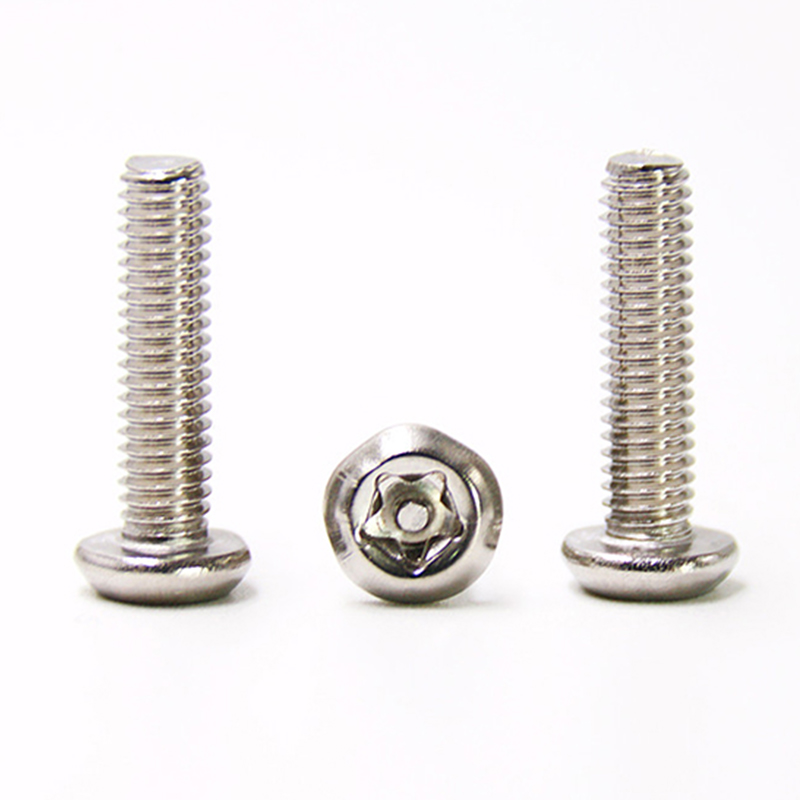 Stainless Steel Button-Head Pentagon Tamper-Proof ScrewA security screw with a pentagon drive and key, intended to deter casual removal of shared apron fittings and make tampering visible.View Product →
This is a deterrent, not a substitute for inspection. Anyone determined enough will get through most hardware, but the goal is to make casual removal inconvenient and to make any tampering obvious at a glance.
Tiedown hardware fails slowly and then all at once, so a short seasonal check catches nearly everything:
Good tiedowns are unglamorous: a sound slab, an anchor suited to it, rated hardware above, and someone who checks the whole assembly once in a while. Get those four things right and the anchor will outlast several sets of chains. If you want to know more about how we make eye bolts, security screws and other small critical fasteners, our company profile is a reasonable place to start.
CONTACT DETAILS

Address:NO. 248-2 Changhongbei Road, Luzhi Town, Wu zhong District,Suzhou City, Jiangsu Province,China.
TEL:+86-13913588597
PRODUCTS
MOBILE TERMINAL



 English
 Español