Telephone: +86-0512-65028068
Content
Auto tag screws are small fasteners with a demanding job: they hold identification plates, license tags, fleet markers, asset labels and access panels where they need to stay put. In our experience, these screws sit at the intersection of three practical needs: reliable clamping force, resistance to weather and vibration, and often a measure of tamper resistance. A screw that works well on an indoor equipment label may not survive a winter of road spray on a vehicle tag, and a screw that is easy to remove for service may be too easy to remove for a public-facing plate.
That is why auto tag screws should be selected as a system, not as a last-minute line item. The head style, drive, thread, material and finish all affect how the tag sits, how long it lasts and who can take it off. Our team’s precision screw manufacturing background has taught us that the best starting point is a clear picture of the mounting surface, the tag material and the service conditions.
An auto tag screw usually passes through a metal or plastic tag, a bracket or a panel, and then bites into a threaded insert, a nut, a backing plate or a formed hole. The joint may see vibration from an engine, road shock, wind load, repeated cleaning or casual attempts at removal. For that reason, the screw needs enough thread engagement to hold torque, a head that distributes clamping load without cracking the tag, and a finish that does not corrode into a rusty stain on the plate.
On vehicles, license plate and fleet tag screws are often exposed to rain, road salt, dust and ultraviolet light. On industrial equipment, tag screws may face oil, coolant or washdown chemicals. On trailers, racks and outdoor cabinets, the same screw may need to resist loosening from constant vibration. Matching the screw to the environment is more important than choosing the lowest-cost part that fits the hole.
The table below compares practical options we see in tag, plate and panel work. The right choice depends on whether the tag will be removed for service, whether the public can reach it, and how much corrosion exposure the joint will face.
| Option | Drive and head style | Typical material | Best use | Security level |
|---|---|---|---|---|
| Standard pan-head machine screw | Cross or slot | Zinc-plated carbon steel or 304 stainless steel | Interior equipment tags and access panels | Basic |
| Flanged hex or washer-head screw | Hex or Torx | Stainless steel or zinc-nickel | License plates and fleet tags exposed to weather | Medium |
| Snake-eye or spanner security screw | Snake-eye, spanner or pin-in-Torx | 304 or 316 stainless steel | Public-facing plates and removable panels | High |
| Pentagon or special-head tamper-proof screw | Pentagon, Tri-groove or custom | Stainless steel or alloy steel | Registration tags, VIN plates and secure ID plates | Very high |
For outdoor auto tag screws, stainless steel is often the simplest answer. Grades such as 304 and 316 resist rust and staining well, and they hold up to repeated washing. Carbon steel can be a cost-effective choice for indoor tags, but it needs a finish such as zinc, zinc-nickel or black oxide, and the finish must suit the exposure. Brass and aluminum are useful when the tag design calls for a particular look or when weight matters, but they need to be matched to the mating material to reduce galvanic corrosion risk.
Head style matters as much as material. A pan or washer head spreads load over a wider area, which helps on thin tags. A countersunk head gives a flatter surface but requires a matching countersink. A hex or Torx drive transmits torque efficiently and is less likely to cam out during installation. For exposed plates, a cap or low-profile head can reduce snagging and make removal less attractive to casual tampering.
 M4 Stainless Steel Pan Head Security ScrewA tamper-resistant pan-head fastener for thin tags and exposed plates, with material, standard and finish options to specify for the installation environment.View Product →
Finish choice also affects appearance. Black oxide, zinc-nickel, polished stainless and anodized aluminum can each suit a different tag design, but the finish should be specified for the environment, not only for the look of the sample. If the tag will be handled often, a coating that wears away quickly may leave bare metal exposed at the head and threads.
When an auto tag screw is easy to remove, the tag is easy to remove with it. That is why many plate and asset-tag applications use security drives such as snake-eye, spanner, pin-in-Torx, pentagon, Tri-groove or other special heads. These designs still allow authorized service with the correct key or bit, but they discourage removal with common hand tools. The goal is not to make removal impossible, because service access still matters. The goal is to make removal deliberate.
 Customized M5 Stainless Steel Number Plate Security ScrewA customized anti-theft screw for number-plate fixation, suited where authorized service access matters but removal with common hand tools should be discouraged.View Product →
For license plates and registration tags, check local rules before choosing hardware. Some jurisdictions specify plate fasteners, thread sizes or mounting points. A security screw should fit the existing insert or nut, sit flush or low against the plate, and leave enough thread engagement for a stable joint. If the plate is recessed, measure the available head height before ordering. If the tag is thin, use a washer or flanged head to avoid pull-through.
A clear specification saves time for everyone. When you send an inquiry for auto tag screws, include the following details so the sample or quote matches the real joint:
If the tag uses a plastic mounting boss, avoid over-torque and consider a thread-forming screw designed for plastic. If the tag uses a metal insert, match the screw thread to the insert and confirm that the screw length will not bottom out. For high-vibration applications, a nylon patch, thread lock or locking washer may be useful, but it should be tested in the actual joint.
Even a well-chosen auto tag screw can fail if it is installed poorly. Use the correct drive bit and keep it fully engaged in the recess. Set the driver clutch low enough to avoid stripping the head or cracking the tag. When mounting a plate, start all screws by hand before tightening, so the tag can shift into alignment. Tighten in a cross pattern if there are four holes, and avoid compressing a soft tag so much that it deforms.
For serviceable tags, keep a small stock of the correct bits and replacement screws. Security heads are effective only when the maintenance team has the right tools. If the plate will be removed often, choose a reusable security drive rather than a one-way break-off screw. If the tag is permanent and theft risk is high, a one-way or break-away design may be appropriate, but confirm that future service will not require destructive removal.
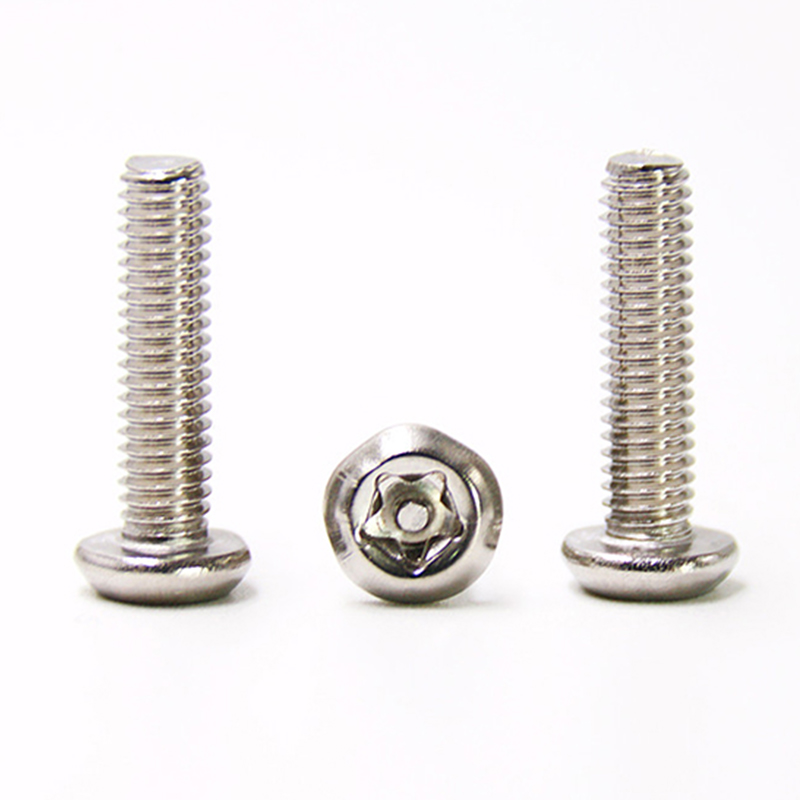 Stainless Steel Button Head Pentagon Tamper-Proof ScrewA pentagon-drive security fastener supplied with a matching key, useful for serviceable tags where the maintenance team keeps the correct bit available.View Product →
Standard auto tag screws cover many common plate and panel jobs, but some projects need a specific head, length, thread, finish or security drive. That is where a custom fastener program helps. We can review a drawing or sample, discuss the mating material and exposure conditions, and propose a practical screw specification. Our production setup includes cold heading, thread rolling, CNC machining and anti-loosening processes, which allows us to work from standard dimensions or from a customer-specific design.
For OEM projects, it is helpful to share the application, target quantity, expected service life and any installation tooling already in use. A small change at the design stage, such as adjusting thread length or choosing a slightly wider head, can prevent cracking, loosening or extra assembly time later. If you are not sure where to start, send a photo of the tag and mounting point along with the basic dimensions. We can help narrow the options and build a sample plan through our custom fastener program.
Auto tag screws may be small, but they carry the reputation of the plate they hold. A secure tag stays readable, a corrosion-resistant screw keeps the mounting clean, and the right security head makes removal a deliberate act rather than an easy one. By matching material, head style, drive and finish to the real service conditions, you can choose a fastener that is simple to install, reliable in use and appropriate for the tag it protects.
CONTACT DETAILS

Address:NO. 248-2 Changhongbei Road, Luzhi Town, Wu zhong District,Suzhou City, Jiangsu Province,China.
TEL:+86-13913588597
PRODUCTS
MOBILE TERMINAL



 English
 Español