Telephone: +86-0512-65028068
Content
When a fastener specification fails only after assembly, the problem is rarely the thread. More often, it is the combination of material grade, head geometry, coating, and tolerance that turns a standard part into a poor fit. That is why many engineers and procurement teams move from stock stainless steel screws to a custom stainless steel fastener. This guide explains what actually matters when specifying a custom part, how production works, and what information a fastener manufacturer needs to quote accurately.
A custom fastener becomes necessary when an off-the-shelf part forces a compromise on head height, thread engagement, drive depth, or appearance. Standard industrial fasteners cover common applications well, but they cannot always satisfy a specific counterbore depth, a flush-fit requirement, or a tamper-resistant drive.
The scope of that work can be seen in our OEM manufacturing overview, where parts are produced from drawings rather than from a standard catalog.
“Stainless” is not one material. The grade determines corrosion resistance, strength, magnetic behavior, and cost. For most custom stainless steel fasteners, the starting point is either 304 (A2) or 316 (A4), but high-strength or high-corrosion applications often require other alloys.
| Grade | Typical Application | Corrosion Resistance | Property Class Example |
|---|---|---|---|
| 304 / A2 | Indoor equipment, electronics, furniture | Good in atmospheric exposure and mild chemical environments | A2-70 |
| 316 / A4 | Marine hardware, food processing, chemical plants | Better resistance to chlorides and acids than 304 | A4-80 |
| Duplex 2205 | Offshore structures, high-stress assemblies | High resistance to pitting and chloride stress corrosion | Custom strength levels |
Property classes define tensile strength. An A2-70 304 stainless fastener has a minimum tensile strength of 700 MPa, while A4-80 typically reaches 800 MPa. For projects that need both corrosion resistance and higher strength, duplex grades or hardened martensitic grades can be considered.
A complete custom specification is more than “M4 x 10 stainless.” It should include thread form, pitch, head profile, drive recess, finish, and any functional coating.
Machine thread, self-tapping thread, and wood thread behave differently under load. For thin sheet metal, a self-tapping point with reduced root diameter lowers installation torque. For plastic, a thread-forming point can reduce boss cracking compared with standard machine threads.
Pan, countersunk, button, wafer, and low-cup heads cover most design needs. In custom stainless steel fasteners, the head height and under-head angle are often adjusted to align with a cover plate or hinge counterbore. The drive recess must be deep enough for tooling; shallow recesses lead to cam-out during automated assembly.
Appearance finishes such as CD pattern, satin brushing, black oxide, and passivation change both visual quality and corrosion behavior. Functional coatings, including nylon patches and sealing coatings, modify friction, locking behavior, or leak resistance without changing the base material.
Most custom stainless steel fasteners are made by cold heading, thread rolling, CNC machining, or a combination of these processes. Cold heading forms the head and shank at high speed while preserving the material’s grain flow. Thread rolling then produces the thread and gives higher fatigue strength than cutting.
CNC machining becomes the preferred route for very small diameters, shoulder screws, or complex step profiles. Secondary operations add functionality: nylon patching locks threads, O-rings and sealing coatings prevent water ingress, and decorative finishes match the final product appearance.
In our 2,000-square-meter facility in Suzhou, more than 200 sets of precision forming, thread rolling, CNC, and secondary processing equipment imported from Taiwan and Japan support this range of work. For non-standard head shapes or thread forms, we also develop cold heading dies and thread rolling dies internally. You can review the production setup on our company profile page.
The range is broader than engineers usually assume. Micro electronics, waterproof housing, and security-sensitive installations all benefit from a fastener that is designed around the product rather than around a catalog.
.jpg) Customized Stainless steel m1 thread locked CD line pentagon screw for iPhone SuAnzhikou is Custom Stainless steel m1 thread locked CD line pentagon screw for iPhone Suppliers and Company in China, Wholesale Stainless...View Product → is a practical example.
Customized Stainless steel m1 thread locked CD line pentagon screw for iPhone SuAnzhikou is Custom Stainless steel m1 thread locked CD line pentagon screw for iPhone Suppliers and Company in China, Wholesale Stainless...View Product → is a practical example.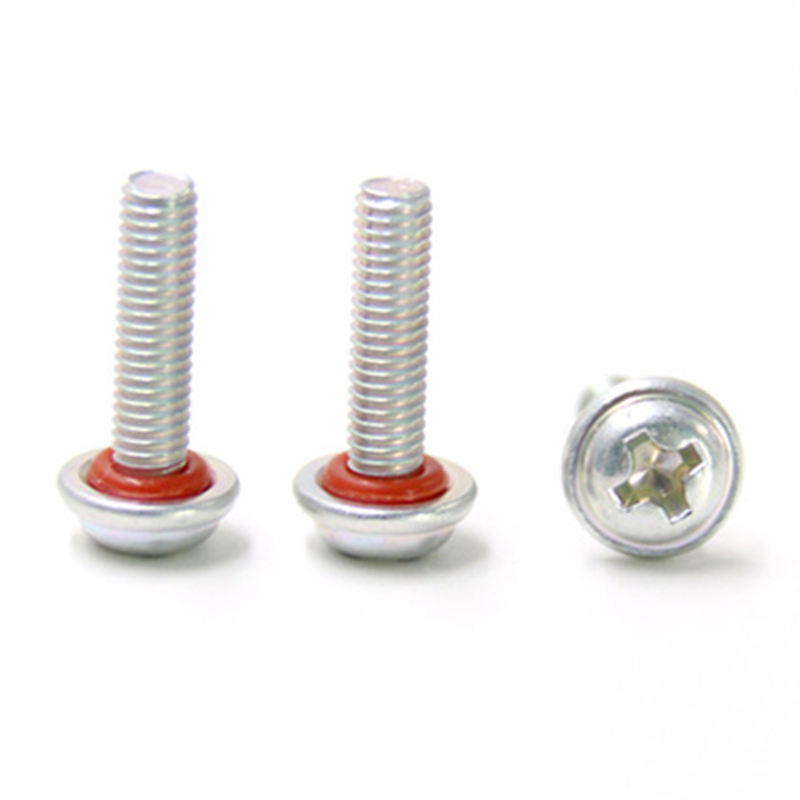 Customized Stainless steel pan washer head sealing ring waterproof screw SupplieAnzhikou is Custom Stainless steel pan washer head sealing ring waterproof screw Suppliers and Company in China, Wholesale Stainless stee...View Product → is often used in lighting housings and access panels.
-1.jpg) Customized stainless steel m5 special head security anti-theft screw for number Anzhikou is Custom stainless steel m5 special head security anti-theft screw for number plate Suppliers and Company in China, Wholesale s...View Product → is a straightforward choice.
Customized stainless steel m5 special head security anti-theft screw for number Anzhikou is Custom stainless steel m5 special head security anti-theft screw for number plate Suppliers and Company in China, Wholesale s...View Product → is a straightforward choice.The fastest way to get a usable quote is to provide complete specifications. A drawing or sample is even better, because it removes ambiguity about head dimensions, tolerances, and thread engagement.
With those details, the manufacturer can evaluate tooling requirements, select the correct process, and provide a realistic lead time. For small volumes, CNC machining may be more economical; for high volumes, cold heading and thread rolling lower the cost per part. Raw material and coating requirements change over time, and the industry news page is a useful place to follow those shifts.
CONTACT DETAILS

Address:NO. 248-2 Changhongbei Road, Luzhi Town, Wu zhong District,Suzhou City, Jiangsu Province,China.
TEL:+86-13913588597
PRODUCTS
MOBILE TERMINAL




 English
 Español
.jpg "Custom Various Head Shapes And Colors Titanium Bolts")
.jpg "ISO7380 Stainless Steel Button Head Hex Socket Allen Screw")
.jpg "M8 Stainless Steel ISO7380 Hex Socket Button Head Screw")
.jpg "Stainless steel 18-8 Hex Socket button head machine screw")