Industry knowledge
How Metal Finishing on Bag Decoration Hardware Affects Both Aesthetics and Longevity
The surface finish applied to decorative bag hardware — whether a screw-back stud, a rivet, a logo plate, or a strap attachment fitting — is the single most visible quality signal on a finished leather or fabric bag. Consumers and buyers evaluate hardware finish as a direct proxy for overall product quality, which means the choice of plating or coating method has commercial consequences far beyond mere aesthetics. However, decorative finishes on bag hardware must simultaneously satisfy visual requirements and survive the mechanical and environmental stresses of everyday bag use: contact with skin oils and sweat, exposure to cosmetics and perfumes, friction against fabric linings, and repeated contact and impact during normal handling.
The most widely used finishes in the bag hardware industry each carry specific performance characteristics that designers and procurement teams must understand when specifying components:
- Gold electroplating (flash vs. heavy deposit): Flash gold plating of 0.05–0.1 microns is standard in fast-fashion accessories and begins showing brass base metal through wear zones within weeks of use. Heavy gold deposits of 0.5–2.0 microns maintain color uniformity and resist abrasion through years of normal contact.
- Antique brass and antique silver: These are intentionally aged finishes produced by applying a base plating layer followed by a darkening chemical treatment and selective polishing. The durability of antique finishes depends heavily on the lacquer or clear coat applied as a final seal — without adequate lacquer protection, the darkened areas continue to change color over time.
- Brushed nickel and satin finishes: Achieved by mechanical abrasion of the plated surface with fine abrasive media before a thin clear protective coat is applied. The directionality of the brush marks must be consistent across all hardware components in the same bag.
- PVD (Physical Vapor Deposition) coatings: Applied in vacuum chambers, PVD coatings provide hardness values of 1500–3000 HV — ten to thirty times harder than electroplated gold — with virtually no dimensional addition to the substrate. PVD hardware maintains mirror or satin finish appearance far longer than plated equivalents under abrasion.
Screw-Back Studs vs. Rivet Studs: Structural and Assembly Differences That Affect Bag Construction
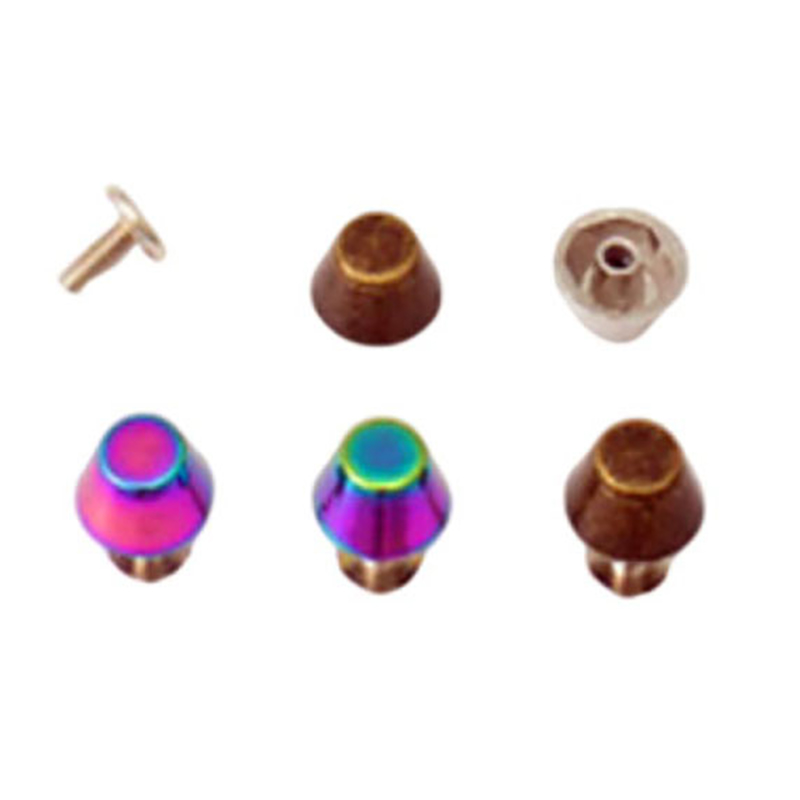
Decorative studs for bags come in two fundamentally different attachment configurations — screw-back and rivet — and the choice between them has implications not only for assembly method and tooling requirements but also for the structural integrity of the attachment over the product's service life. Screw-back studs consist of a decorative cap component with a threaded post that passes through the leather or fabric substrate and receives a threaded back plate or nut on the reverse side. The threaded connection allows the stud to be installed, adjusted, and removed without damaging the substrate — a critical requirement for samples, prototypes, and limited-edition products where hardware changes must be made without replacing cut leather panels.
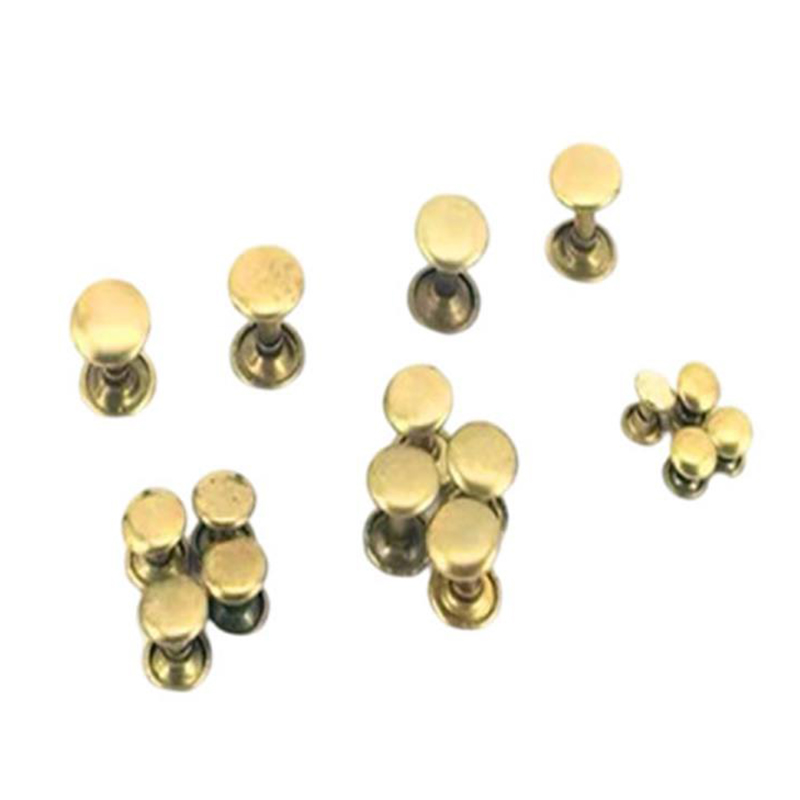
Rivet studs use permanent cold-deformation of a post or tube to secure the hardware through the substrate. Once set, they cannot be removed without destroying either the rivet or the surrounding material. The advantages are speed of installation on automated or semi-automated setting machinery, lower per-unit hardware cost, and a slightly lower-profile back plate. The mechanical holding strength of a correctly set rivet stud is generally higher than a screw-back equivalent of the same diameter because the deformed metal mechanically interlocks with the substrate. However, if the rivet is over-set — a common result of worn setting dies or incorrect press force calibration — the post flares excessively, creating a raised back plate ring that cuts into leather linings and reduces the effective clamping area.
Base Metal Selection for Decorative Bag Hardware: Brass, Zinc Alloy, and Iron Compared
The base metal of a bag hardware component is entirely hidden under plating or coating in the finished product, yet it determines the weight, corrosion resistance, machining precision, plating adhesion quality, and long-term appearance stability of the hardware far more than the surface finish alone.
| Property |
Brass (C26000 / C36000) |
Zinc Alloy (Zamak 3/5) |
Iron / Steel |
| Density (g/cm³) |
8.4–8.7 |
6.6 |
7.8 |
| Corrosion Resistance |
Excellent |
Moderate (zinc oxidizes at plating pores) |
Poor without coating |
| Plating Adhesion |
Excellent |
Good (requires copper strike layer) |
Good |
| Dimensional Precision |
Very High (machinable to ±0.01mm) |
Moderate (die casting tolerances) |
High (stampings and screw machine parts) |
| Weight Perception |
Premium (solid feel) |
Light (often perceived as cheap) |
Moderate |
| Relative Cost |
High |
Low |
Low to Moderate |
The most consequential failure mode specific to zinc alloy bag hardware is inter-granular corrosion beneath the plating layer, commonly called "zinc pest" or "white rust migration." When plating pores or micro-scratches expose the zinc alloy substrate to moisture and oxygen, zinc oxide forms preferentially at grain boundaries and beneath the plating layer. The volumetric expansion of the zinc oxide pushes the plating outward, creating blisters and flaking that are impossible to repair. Brass hardware, by contrast, forms a stable, adherent patina that seals the surface and self-limits further corrosion, explaining why properly plated brass bag hardware retains its appearance through the entire service life of the product.
Thread Specifications for Decorative Screw Hardware on Luxury Bags
Precision thread quality in screw-back bag decorations is an often-underestimated factor in both assembly line efficiency and long-term product reliability. For decorative bag hardware, thread specifications diverge from industrial fastener standards in several important ways. The thread pitch selected for a given stud diameter is typically coarser than the equivalent metric fine pitch used in engineering applications, because coarser threads are more tolerant of the slight misalignment that occurs when threading through leather, canvas, or synthetic substrates by hand. The key dimensional parameters that must be specified and controlled for consistent decorative screw hardware performance include:
- Post diameter and pitch combination: Must be matched to the back plate thread for a consistent fit class — typically a free-running 6g/6H fit for hand assembly or a closer 5g/5H fit for torque-tool installation.
- Thread engagement length: For studs on load-bearing locations (handle bases, strap D-ring attachments), a minimum of three full thread turns of engagement is required to develop adequate holding force in the assembled joint.
- Post length tolerance: The post must be long enough to fully engage the back plate thread but short enough that no thread protrudes beyond the seated back plate. A post length tolerance of ±0.1mm is typically specified for quality bag hardware.
- Thread root radius: A controlled root radius rather than a sharp root in the thread profile reduces stress concentration at the base of each thread, improving fatigue resistance under the repeated vibrational and impact loads that bag hardware experiences during normal use.
Nickel-Free Hardware Requirements in the Bag Industry: Compliance and Alternative Finishes
Nickel allergy affects approximately 10–15% of the general population and is significantly more prevalent among women — the primary consumer of fashion bags. The European Union's REACH regulation (Annex XVII, Entry 27) strictly limits nickel release from articles intended for prolonged skin contact to 0.5 μg/cm²/week, a threshold that standard nickel-plated hardware frequently exceeds. For hardware manufacturers, nickel-free compliance requires rethinking the conventional electroplating stack. The most commercially established nickel-free alternatives include:
- Palladium sublayer: Palladium provides a bright, hard sublayer with excellent plating adhesion and zero nickel content. It is the sublayer of choice for the highest-end luxury hardware where both nickel compliance and maximum finish quality are required simultaneously.
- Tin-copper alloy sublayer: A binary tin-copper alloy deposit provides a ductile, adherent sublayer over brass or iron substrates without nickel. Significantly more cost-effective than palladium for mid-market applications.
- Trivalent chromium plating: Unlike hexavalent chrome (now restricted under RoHS and REACH), trivalent chromium processes produce a silver-toned, hard decorative finish that is both nickel-free and free of hexavalent chromium.
- PVD coatings: PVD coatings contain no nickel and produce no nickel migration under any use condition. For brands that have made a full commitment to nickel-free hardware across their range, PVD provides the most durable and regulation-proof solution.
Dimensional Tolerance Control for Logo and Emblem Decorations on Bag Hardware
Logo plates, brand emblems, and monogram decorations on bags represent the highest-visibility hardware component in any product. For hardware manufacturers producing branded decorative components, dimensional consistency across a production batch is not merely a technical requirement but a brand protection obligation. The critical dimensions for logo and emblem bag hardware that require tightest tolerance control are profile flatness, engraving or embossing depth consistency, and edge sharpness uniformity. Flatness specifications of 0.05mm or better across the full plate length are standard for premium hardware and require precision CNC milling or coining operations rather than die casting alone.
Engraving Depth and Plating Interaction
A specific technical challenge in logo hardware production is the interaction between engraving or embossing depth and the subsequent plating process. Plating deposits preferentially on convex surfaces and high points due to the electric field distribution in the plating bath, which means the floor of an engraved channel receives a thinner deposit than the surrounding flat surface. Designers and hardware procurement teams should specify engraving depths that are either deep enough to be decoratively effective at reduced plating thickness (typically above 0.3mm for most finishes) or request a plating specification with a minimum thickness measured at the channel floor rather than the flat surface.
For custom logo hardware requiring engraving depths below 0.2mm, laser engraving after plating — rather than pre-plating mechanical engraving — ensures consistent plating thickness across the entire surface while maintaining razor-sharp letter definition. This sequence requires the plating specification to account for the slight color variation between the laser-engraved base metal exposed in the channels and the plated surrounding field, which is typically addressed through a post-engraving oxide or patination treatment that harmonizes the two surface colors.

 English
 Español
.jpg "Golden customized letter logo prong on back metal plate for bag")
.jpg "6mm Double side brass Rivet with hanging enamel for clothes&bag")
.jpg "10mm DIY Gold Claw Rhinestone Rivet Metal Studs Spikes For Shoes")
.jpg "Colorful fashion crystal stud diamond strass rivet for garment")
.jpg "Different color brass double side rivets for luggage leather")
.jpg "New design brass double side rivets for bag and suitcase")
.jpg "New design customized 12mm metal rivet grommets for handbag")
.jpg "Thin flat head solid brass double side rivets for leather")