Telephone: +86-0512-65028068
Content
A license plate is one of the easiest parts of a vehicle to steal: four standard Phillips screws, a common screwdriver, and less than a minute of work. The same weakness shows up in park signage, restroom partitions, bicycle components, solar mounting rails, and outdoor electrical enclosures, anywhere an exposed fastener meets a motivated thief or vandal. Anti-theft screws address the problem at its source by removing the drive interface that ordinary tools rely on. The trade-off is just as real: the feature that blocks a thief also complicates legitimate maintenance. Choosing well means matching the drive type, material, and key logistics to how often the assembly actually needs to be opened, not simply buying the most exotic head available.
Anti-theft screws, also sold as security screws or tamper-proof screws, are conventional threaded fasteners whose drive recess or head profile has been deliberately altered so that flat, Phillips, hex, and standard Torx bits cannot grip them. Installation and removal require a matching driver or key. The thread, pitch, head height, and material can be identical to a standard screw, which means retrofitting an existing assembly usually takes nothing more than swapping the fastener and keeping the right key on hand.
It helps to separate two terms that sellers often blur. Tamper-resistant designs, such as snake eye and pin-in Torx drives, use modified but commercially obtainable bits; they stop opportunistic interference, casual theft, and unsupervised disassembly. Higher-security designs, such as tri-groove, pentagon, and heptagon drives, rely on geometry with little retail distribution of matching tools, so an attacker would have to source or fabricate a driver, which takes time and leaves evidence. No screw is theft-proof against someone with an angle grinder and unlimited patience. The engineering goal is to push the time, noise, and skill required past the point where the payoff justifies the effort.
Drive geometry determines both the level of protection and the long-term cost of ownership, because every technician who legitimately services the assembly needs the matching tool. The table below summarizes the drives that dominate industrial and municipal specifications.
| Drive Type | Matching Tool | Relative Resistance | Typical Applications |
|---|---|---|---|
| Snake eye (spanner, two-hole) | Spanner bit with two round pins | Moderate; bits are commercially available | License plates, signage, restroom partitions |
| Pin-in Torx (six-lobe with center pin) | Torx bit with a hollow center | Moderate | Electronics enclosures, kiosks, appliances |
| Tri-groove | Three-blade tri-groove driver | High; drivers rarely sold at retail | Solar mounts, EV chargers, public infrastructure |
| Pentagon (five-sided) | Pentagon key supplied with the screws | High; keys are closely controlled | Telecom cabinets, meters, transit hardware |
| Heptagon (seven-sided) | Heptagon key | Very high; geometry resists improvised tools | High-security assemblies, custom equipment |
Two practical notes follow from this comparison. First, snake eye and pin-in Torx remain the most popular choices for public-facing hardware because replacement bits are inexpensive and service crews already carry them, yet the average passerby does not. A typical example from current production is:
M4 stainless steel pan head security screw with snake eye drive.jpg) M4 Stainless Steel Pan Head Snake Eye Security ScrewA stainless steel pan head screw with a snake eye drive, a common choice for public-facing hardware since service crews carry the inexpensive bits but casual tampering is deterred.View Product →
M4 Stainless Steel Pan Head Snake Eye Security ScrewA stainless steel pan head screw with a snake eye drive, a common choice for public-facing hardware since service crews carry the inexpensive bits but casual tampering is deterred.View Product →
Second, pentagon and heptagon heads shift security from the bit to key control. Because the keys are not standardized across the market, they are usually supplied together with the screws, and buyers should treat spare keys as part of the bill of materials rather than an afterthought.
License plates are the most familiar application, and many vehicle owners replace their factory hardware within days of buying a car. Municipal and facility managers apply the same logic across a much wider footprint: street and traffic signs, park benches, mailbox banks, charging stations, ticket machines, stadium seating, and public restroom cubicles all lose hardware to theft and vandalism when standard screws are used. Solar farm operators and telecom contractors specify tri-groove or pin-in Torx fasteners on enclosure doors and mounting rails, where a single removed panel screw can expose copper cabling worth far more than the entire set of security screws.
Plate hardware is a sub-category of its own, because the screw must survive road salt, vibration, and automatic car washes while still engaging its keyway cleanly. A representative part from this category is:
customized stainless steel M5 special head anti-theft screw for number plates-1.jpg) Custom M5 Stainless Steel Anti-Theft Number Plate ScrewThis M5 special-head security screw in stainless steel suits number plate mounting, where parts must endure road salt, vibration, and car washes while still engaging their keyway cleanly.View Product →
Custom M5 Stainless Steel Anti-Theft Number Plate ScrewThis M5 special-head security screw in stainless steel suits number plate mounting, where parts must endure road salt, vibration, and car washes while still engaging their keyway cleanly.View Product →Security only matters if the screw is still intact and removable by its own key after five years outdoors. For most exterior installations, 304 stainless steel offers a practical balance of corrosion resistance, strength, and cost. Coastal environments, road-salt exposure, and industrial atmospheres justify the upgrade to 316 stainless, whose added molybdenum resists pitting and chloride attack. Carbon steel screws with black oxide, zinc plating, or nickel plating cost less and deliver higher tensile strength, which suits indoor equipment, kiosks, and any joint shielded from weather.
Two add-ons are worth considering at the specification stage. A nylon patch applied to the threads acts as a pre-applied thread locker, holding the screw in place under the vibration typical of vehicles, rail hardware, and machinery. A captive washer or flanged head keeps a loose screw from dropping into equipment during servicing. Both are standard requests on custom orders and add only marginally to unit cost.
Pentagon hardware illustrates why key supply belongs in the purchase order rather than a follow-up email, since screws of this type are normally delivered complete with their own keys, as in this production example:
stainless steel button head pentagon tamper-proof screw with key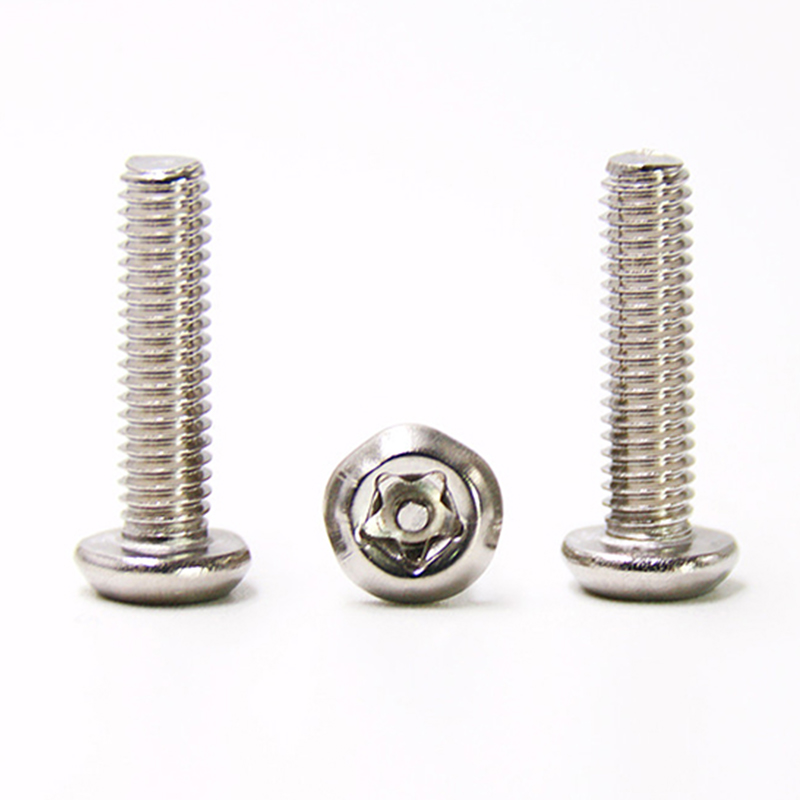 Stainless Steel Button Head Pentagon Tamper-Proof Screw with KeyA stainless steel button head screw with a pentagon drive, supplied together with its matching key since pentagon bits are not standardized and belong in the original purchase order.View Product →
Standard drives cover most projects, but some programs need more: a proprietary drive that prevents even authorized third parties from sourcing matching bits, a special head height that sits flush inside a housing, or a combined requirement such as sealing plus tamper resistance. These are custom manufacturing jobs rather than catalog purchases, and they depend on a supplier that controls its own forming tools. Prospective buyers can review the custom screw OEM service to see how drawing-based orders are handled, from sample confirmation through batch delivery.
Supplier capability is worth verifying directly. Suzhou Anzhikou Hardware Technology Co., Ltd., the company behind screwsmicro.com, describes on its company introduction page a 2,000-square-meter factory equipped with more than 200 sets of imported cold heading, thread rolling, CNC, and thread-locking machinery. In-house cold heading and thread rolling matter for security screws in particular, because the altered drive geometry is formed into the head itself and cannot be added reliably as a secondary step.
Anti-theft screws work by starving standard tools of the interface they need, and the right choice is the one that prices a thief's effort well above the value of what sits behind the screw. Start from the service schedule, select the drive and material accordingly, order the keys together with the hardware, and treat the screws as one layer in a defense that also includes placement, lighting, and alarms. Managed this way, a set of security fasteners costing a few dollars protects equipment worth hundreds or thousands.
CONTACT DETAILS

Address:NO. 248-2 Changhongbei Road, Luzhi Town, Wu zhong District,Suzhou City, Jiangsu Province,China.
TEL:+86-13913588597
PRODUCTS
MOBILE TERMINAL




 English
 Español
.jpg "New design customized 12mm metal rivet grommets for handbag")
.jpg "M8 Stainless Steel ISO7380 Hex Socket Button Head Screw")
.jpg "Non standard customized stainless steel eye bolt")
.jpg "ISO7380 Stainless Steel Button Head Hex Socket Allen Screw")
.jpg "Button head torx titanium alloy screw")