Telephone: +86-0512-65028068
Content
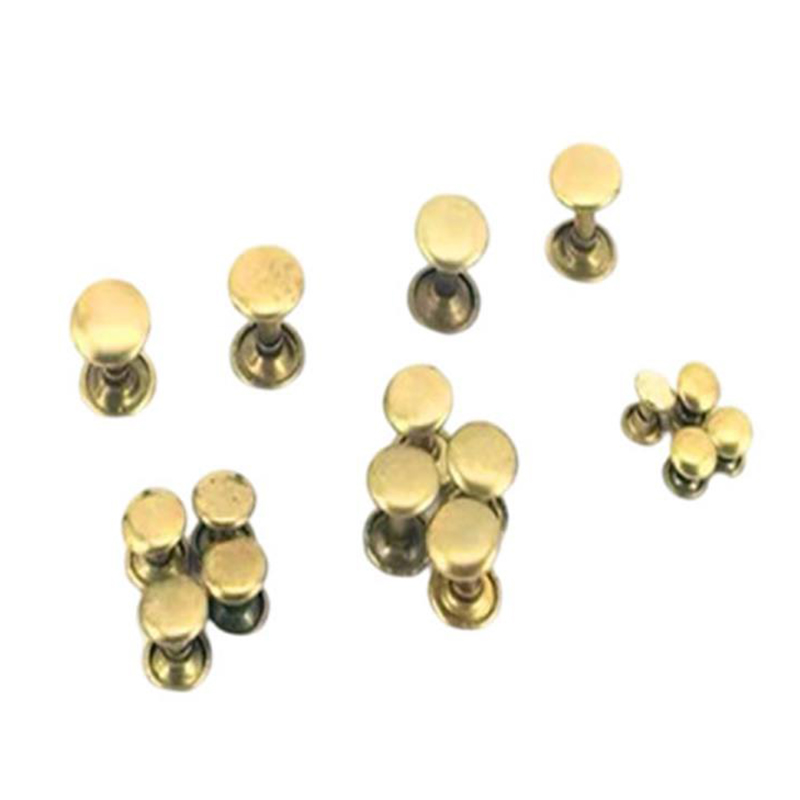
Brass chicago screws — also known as sex bolts, barrel nuts, screw posts, or binding posts — are two-piece threaded fasteners consisting of a male screw and a female barrel that thread together to clamp materials between them. The barrel component features a flat or slightly domed head on one side and an internally threaded hollow shaft, while the screw component has a flat or domed head on its end and an externally threaded shank that inserts into and engages the barrel's internal thread. When the two pieces are assembled through a drilled hole or punched slot in the material being joined, tightening the screw draws the heads together and secures the layers firmly without requiring access to a nut on the reverse side — making them exceptionally useful wherever a clean, finished appearance is needed on both faces of the assembled piece.
Brass is the material of choice for chicago screws in the vast majority of craft, leatherworking, bookbinding, and decorative hardware applications. The alloy — typically a combination of copper and zinc in proportions of 60–70% copper and 30–40% zinc — delivers an ideal combination of properties for these uses: it is soft enough to be machined and knurled with fine detail, resistant to corrosion without requiring protective coatings, naturally antimicrobial, and produces the warm golden finish that is aesthetically compatible with leather goods, book covers, menus, badge holders, and decorative hardware. Brass chicago screws also take well to surface finishing processes including polishing to a mirror shine, antique patination, and lacquering for long-term finish preservation.
.jpg)
The versatility of brass chicago screws makes them one of the most widely used specialty fasteners across a surprisingly broad range of industries and DIY applications. Their ability to join multiple layers of material with a finished appearance on both sides, combined with the fact that they can be disassembled and reassembled repeatedly without damage, gives them capabilities that permanent fasteners like rivets or adhesives cannot match.
Brass chicago screws are manufactured in a wide range of sizes to accommodate different material thicknesses and holding requirements. The two critical dimensions when selecting chicago screws are the shaft diameter and the barrel length — the barrel length must match or slightly exceed the total thickness of the materials being joined to allow the screw to engage fully without bottoming out before clamping force is achieved. The following table summarizes the most commonly available sizes and their typical applications:
| Screw Size | Shaft Diameter | Common Barrel Lengths | Typical Use |
| #6-32 | 3.5 mm (0.138") | 3 mm – 12 mm | Light leather, paper portfolios, badge holders |
| #8-32 | 4.2 mm (0.164") | 3 mm – 25 mm | Leather goods, bookbinding, menus |
| #10-32 | 4.8 mm (0.190") | 6 mm – 38 mm | Thick leather, holsters, multi-layer assemblies |
| 1/4"-20 | 6.35 mm (0.250") | 6 mm – 50 mm | Heavy-duty leather, furniture, signage panels |
| M4 | 4.0 mm | 4 mm – 20 mm | European leatherwork, bookbinding (metric) |
| M5 | 5.0 mm | 5 mm – 30 mm | Medium hardware, display mounting (metric) |
When measuring for the correct barrel length, calculate the total compressed thickness of all materials to be joined — including any washers or reinforcement plates — and select a barrel length that equals or is 0.5 to 1 mm shorter than this total thickness. A barrel that is too long will prevent the screw from developing adequate clamping force; a barrel that is too short will cause the screw to bottom out in the barrel thread before the heads clamp the material, leaving the joint loose. For soft materials like leather that compress under clamping load, measuring uncompressed thickness and selecting a barrel 1 to 2 mm shorter than the measured thickness is advisable.
Brass chicago screws are available in several head profile and drive configurations, each suited to different aesthetic preferences and installation tool requirements. The head style affects both the visual appearance of the finished piece and the surface contact area available for clamping.
The most common configuration for both the screw and barrel components, flat head chicago screws sit flush with or slightly above the material surface and present a clean, minimal profile. The slotted drive is traditional and compatible with any flat-blade screwdriver, while Phillips drive allows faster tightening with less risk of the driver slipping off center during installation. Flat head designs are the standard choice for bookbinding, document portfolios, and any application where a low-profile fastener is desired.
Domed head chicago screws feature a convex upper surface that sits proud of the material and creates a decorative raised appearance. These are widely used in leatherwork where the visible fastener head is intended as a design element — the polished brass dome catches light and adds visual interest to belts, bags, and holsters. Domed barrel components are common in equestrian hardware and premium leather goods where both faces of the assembly are visible and the fastener is expected to contribute to the piece's aesthetic.
Some chicago screw variants feature a knurled or winged head designed for hand-tightening without tools — these are particularly useful in menu binders, sample books, and any application where the contents are changed frequently by non-technical users. Knurled heads provide sufficient grip for hand installation while maintaining an acceptable clamping force for light-duty material retention.
Proper hole preparation is critical to achieving a tight, professional-looking installation with brass chicago screws. The hole diameter through the material must be slightly larger than the barrel shaft diameter to allow the barrel to pass through without binding, while remaining small enough to prevent the barrel from rotating when the screw is tightened. For most applications, a hole diameter 0.2 to 0.5 mm larger than the barrel shaft diameter is appropriate — for example, a 4.5 mm hole for a #8-32 barrel with a 4.2 mm shaft diameter.
In leather, holes are most cleanly produced with a hollow punch of the correct diameter used on a cutting mat with a mallet — a rotary punch or drive punch produces cleaner edges than a drill, which tends to tear leather fibers rather than cut them. In paper and card materials, a single-hole punch or drill press with a sharp brad-point bit produces clean holes without tearing. In wood or plastic, a sharp twist drill or Forstner bit produces the cleanest hole. For all materials, deburring the hole edges before installing the chicago screw ensures the barrel seats flat and the head clamps evenly against the surface.
Installing brass chicago screws correctly ensures maximum clamping strength, clean appearance, and long-term joint integrity. The following practical steps cover the installation process from material preparation through final tightening:
One of the most practically useful features of the chicago screw system is the availability of barrel extenders — additional barrel sections that thread onto an existing barrel to increase the total clamped length. An extender is a short barrel segment with internal threads on both ends, allowing a standard barrel to be lengthened incrementally to accommodate thicker material stacks than a single barrel can span. This makes chicago screws particularly versatile for bookbinding applications where the number of pages — and therefore the spine thickness — varies between editions or is built up gradually over time.
Extenders are available in lengths from 3 mm to 25 mm in the common screw sizes and are manufactured from the same brass alloy as the primary barrel components, ensuring consistent appearance and compatible threading. When using extenders, verify that the thread engagement between each pair of components is at least 1.5 times the thread pitch to ensure adequate joint strength — very short thread engagement in soft brass can strip under the clamping loads generated in thick material assemblies.
Uncoated brass naturally develops a patina over time through oxidation of the copper content, gradually shifting from bright golden yellow toward a deeper amber and eventually a brown-green tone. Whether this patination is desirable depends entirely on the application — in antique-style leather goods and traditional bookbinding it is often welcomed as a sign of age and authenticity, while in modern corporate or retail applications a consistently bright finish may be required.
To maintain a bright brass finish, clean chicago screws periodically with a soft cloth dampened with a mild brass cleaner or a paste of lemon juice and baking soda, rinse with clean water, and dry immediately to prevent water spotting. After cleaning, a thin application of clear lacquer or Renaissance wax creates a barrier against further oxidation and fingerprint tarnishing. For applications where a consistent antique or oxidized finish is desired from the outset, brass chicago screws can be chemically patinated using liver of sulfur solution, which produces a controlled dark brown to black oxidized finish that can be selectively buffed to highlight the raised surfaces and create an aged appearance consistent with traditional craft and bookbinding aesthetics.
CONTACT DETAILS

Address:NO. 248-2 Changhongbei Road, Luzhi Town, Wu zhong District,Suzhou City, Jiangsu Province,China.
TEL:+86-13913588597
PRODUCTS
MOBILE TERMINAL




 English
 Español
.jpg "Brass trigger swivel brass spring snap hook for bag")
.jpg "Thin flat head solid brass double side rivets for leather")
.jpg "New design customized 12mm metal rivet grommets for handbag")
.jpg "New design brass double side rivets for bag and suitcase")